

32 Inch wheels are here!
Which Width Tires Fit on Which Width Rims?
Tire and rim widths explained
By Lennard Zinn
Rim width should be directly tied to tire size. While an automotive tire store would not mount a tire on a car if it didn’t have the specific number code indicating its compatibility with the rim, cyclists often buy tires of the width they want without thinking about their rim width. And in the early days of wider road rims, one of their selling points was that you could mount a narrow tire on a wide rim and get the cornering performance of a wider tire without the weight of a wider tire. Some of those combinations riders were using back then, like a 700 × 23C tire on a rim of 21mm inner width when the Hed Ardennes appeared in 2008, are now understood to have insufficient retention for safety. The danger is exacerbated with hookless rims, tubeless tires, and carbon rims.
The ETRTO (European Tyre and Rim Technical Organization) created the guidelines for the below chart of approved nominal tire widths for various inner-width rims. Here it is:
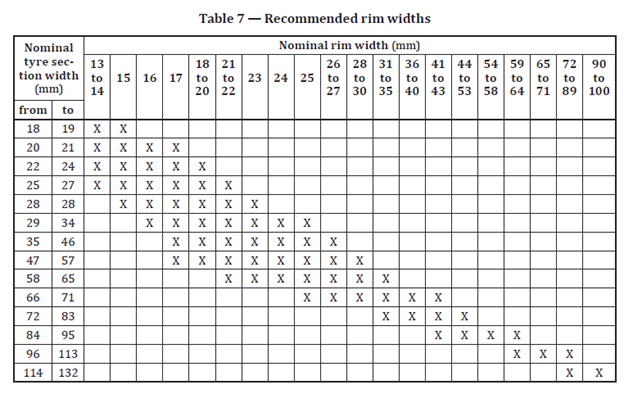
Similar charts have been published by other tire and rim companies, especially makers of hookless rims. Those brands also specify maximum tire pressures on their hookless rims, because the absence of rim-wall hooks to grab the tire bead creates less tire-retaining friction than do hooked rims. Challenge says this reduction in rim-wall-to-tire-sidewall friction is 30%.
The below chart of tire width vs. inner rim width is one that I made combining charts I had received from Schwalbe and Mavic; the Mavic chart has both hookless (“straight-side type”) and hooked (“crotchet type”) rims. I added columns after each set of numbers of the minimum and maximum percentage of tire width that the rim inner width can be. I have the Mavic chart in the 6th edition of Zinn and the Art of Road Bike Maintenance and in the 7thedition of Zinn and the Art of Mountain Bike Maintenance.
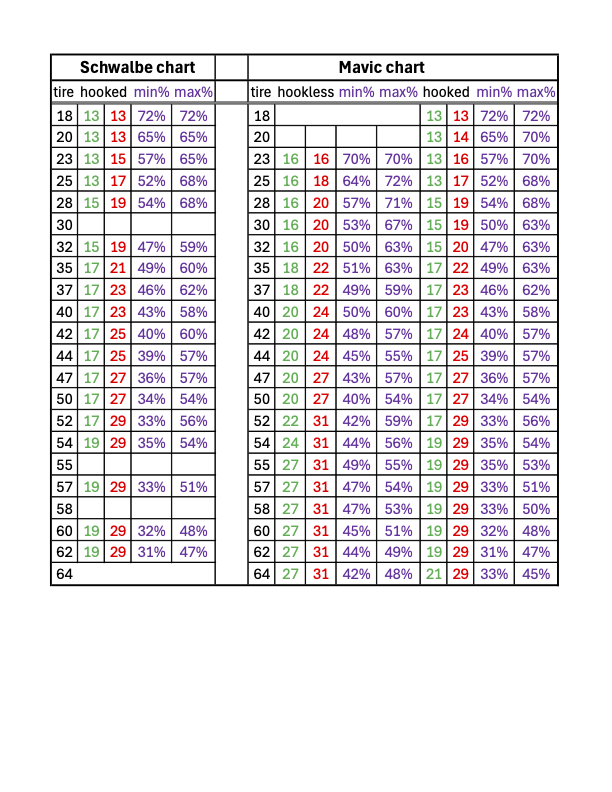
The Schwalbe-supplied chart is only for hooked rims and lacks four of the tire sizes that appear on the Mavic chart, namely 30, 55, 58, and 64mm. It also only has odd-number-width rims. Its numbers are identical to the hooked-rim specs on the Mavic chart, except even rim widths have been rounded down to the next smaller odd rim width.
As for mounting a narrow tire on a wide rim to make it wider without the heavier weight of a wider tire, you can see that a 23mm tire is not approved for use on a rim with an inner width greater than 16mm. And that the narrowest tire that can be used on a 21mm-inner-width rim is 35mm—not a 23mm or even a 25mm one!
The ISO chart, however, allows a much wider range of tire widths with each rim width. What’s odd is that the ISO chart appears to conflict with some of its own recommendations. Look at this Zipp Hookless Rim Tire Compatibility Chart, scrolling down and opening, for instance, the Zipp 353 NSW, a hookless rim with a 25mm inner width. Its “ISO-certified tires” width range is 29-40mm, although some 28mm tires also appear under “Dual Tested Tires” (tested by both Zipp and the tire brand). The 29mm minimum tire width agrees with the above ISO chart, but the 40mm maximum is far less than what the above ISO chart shows for a 25mm inner-width, which appears to be a 66-71mm tire width! Perhaps this has to do with the fact that the ISO chart does not specify hookless or hooked rims, and the Zipp 353 NSW is a hookless rim. But the Mavic chart for a 25mm-width hookless rim seems to allow tires in the 44-55mm width range! That’s at least closer to the max of 40mm on the Zipp chart.
Clear as mud, right?
Tire/Rim Calculations vs. The Real World
The ISO recommendations are based on the ISO 5775 bike tire-rim rule, which says that for a safe fit, the tire's BSD must exactly match the rim's bead seat diameter, and the internal rim width should ideally be 55%–65% of the tire width. Specifically, it says, “The inner width of the rim on which the tire is mounted should be about 65% of the tire's nominal section width for tires smaller than 30 mm and 55% for those larger.” The “nominal tire section width” is measured when the tire mounted on a “design rim” of the specific width at which a tire is engineered to measure “true to size.”
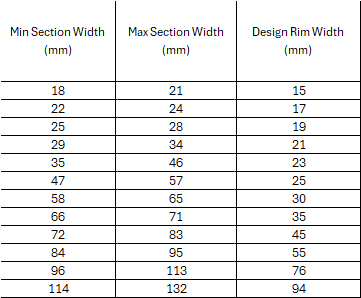
You can see that the 65% guideline for tires smaller than 30mm agrees with the combined Mavic/Schwalbe chart above except for the 18mm-wide tire on the 13mm-wide rim at the top. And notice that the 55% guideline for tires larger than 30mm agrees with the combined Mavic/Schwalbe chart up to a 54mm-wide tire, and after that, the percentages are lower.
Here is a more legible version of the ISO chart based on that ISO 5775 40% rule; this chart includes a column showing the design rim for the “true to size” measurement for each tire size. Again, this allows a very wide range of tire widths around those 55% and 65% guidelines.
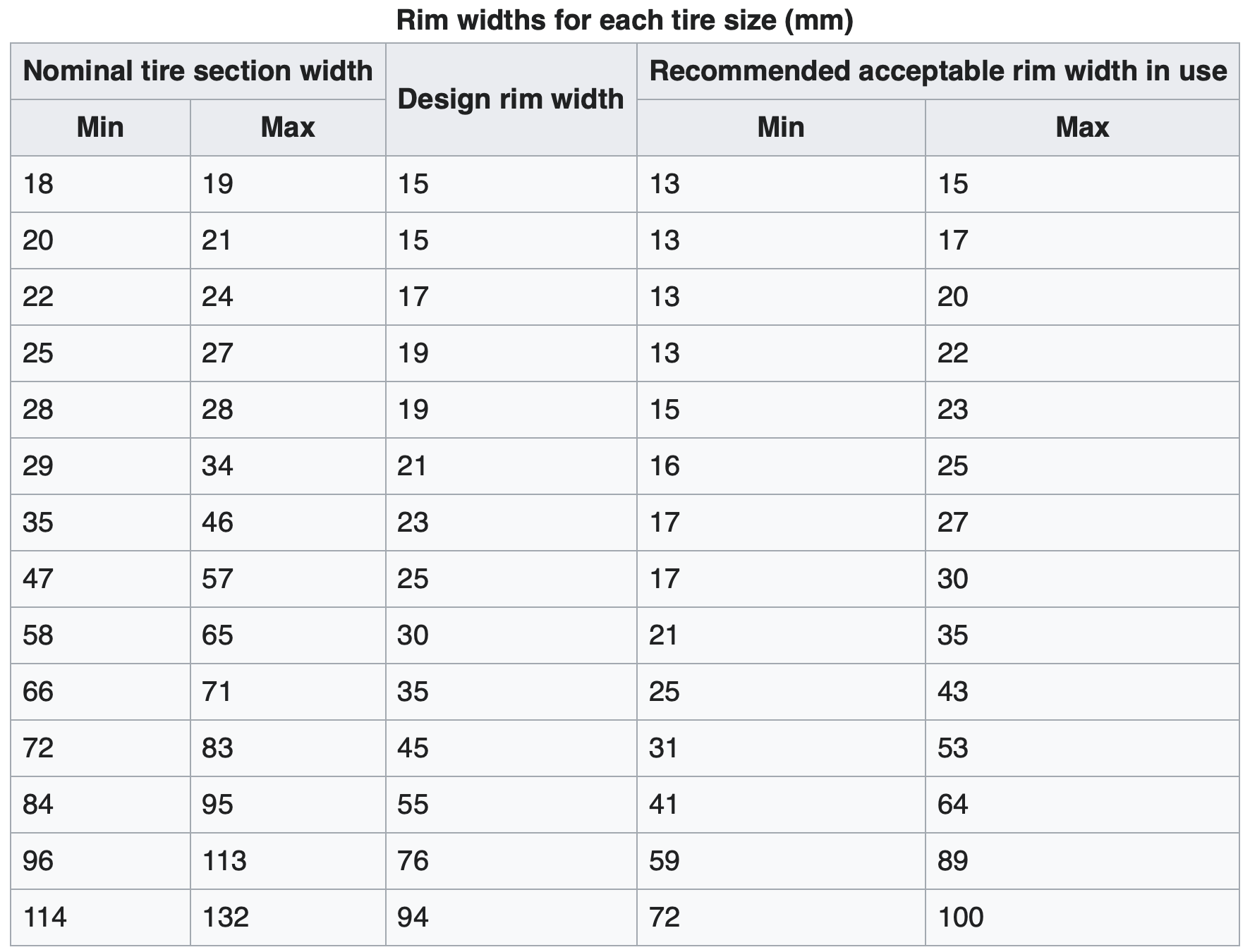
The ISO calculation is intended to account for worst-case scenarios—the smallest possible tire bead on the widest possible rim tolerance—to ensure a safety buffer.
Beyond the math, there are several mechanical variables that a static chart cannot fully capture:
- Rim Width Variation: Inner rim width can fluctuate slightly based on tire pressure or braking forces (on rim-brake models). Even spoke tension can marginally affect the diameter of the bead shelf.
- Tire Construction: Variations in the molded shape of the bead and ability of the bead to stretch and by how much depend on how the beads are wound and what they are made out of.
- Hooks vs. Hookless: The presence or absence of a rim hook (Crotchet Type vs. Straight Side, a.k.a. hookless) significantly changes the tire retention force (coefficient of friction) and hence the safety margin.
Tire and rim sizing
Bike tire size is not always obvious from the dimensions listed on the sidewall or packaging. Unlike traditional tire sizing, the international standard numbering system for bicycle tires and rims is clear and comprehensible. The first number in the “ISO” (International Organization for Standardization) code is the outer width of the tire or the inner width of the rim (“W” in the below Fig. 7.19 from the 6th edition of Zinn and the Art of Road Bike Maintenance). The second number is the tire or rim’s bead seat diameter (“BSD” in Fig. 7.19): the diameter of the ledge on which the tire bead seats.
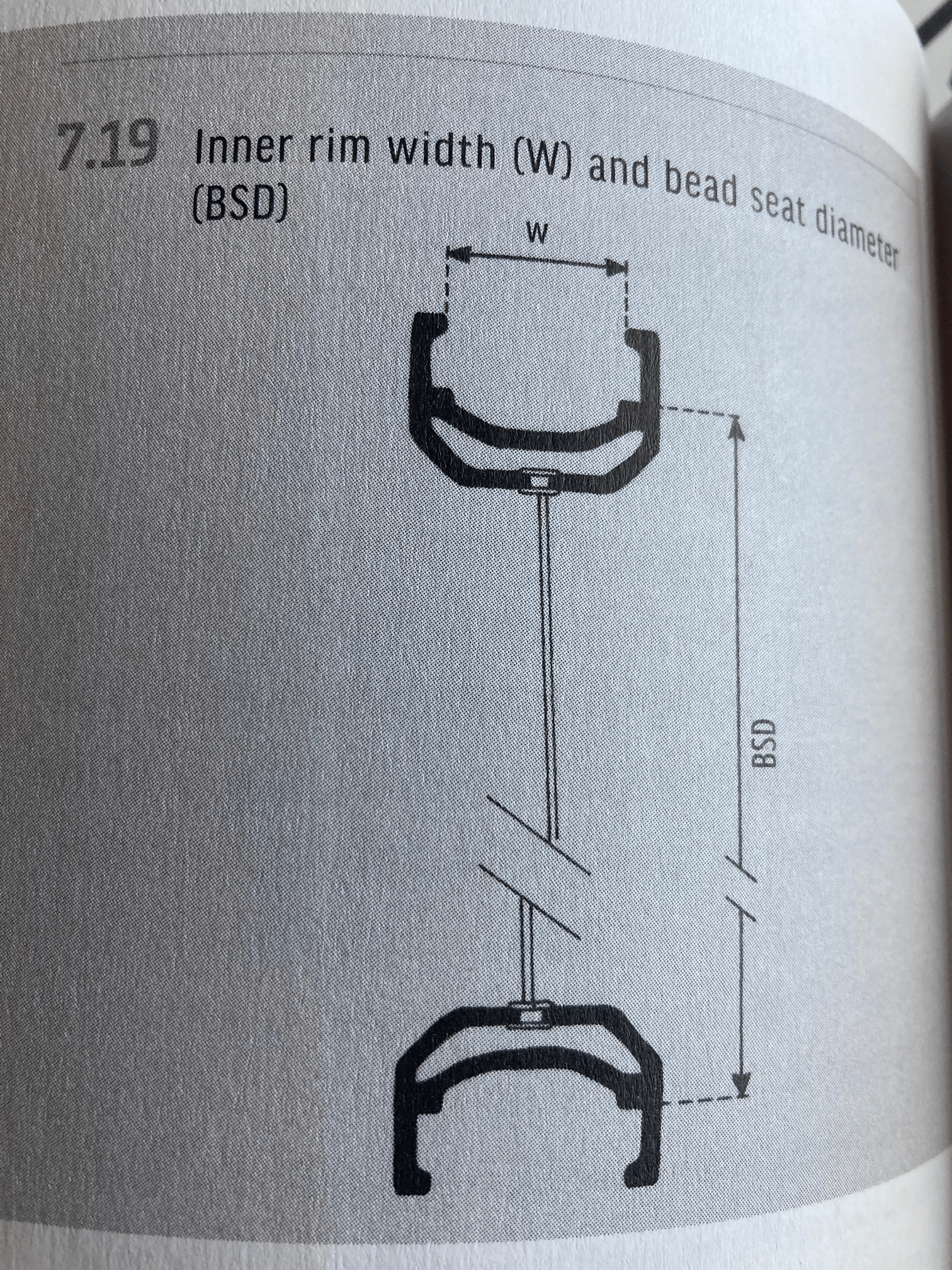
While their ISO code usually appears somewhere on them, tires and rims are usually not sold by those codes, but rather by traditional sizing delineations with far-back roots resulting in bewildering coding in which different numbers often mean the same diameter. In late February I posted this blog explaining tire sizing and labeling.
Thanks for reading.
― Lennard
As a frame builder, Lennard Zinn has been designing and building custom bicycles for over 42 years; he founded Zinn Cycles in 1982 and co-founded Clydesdale Bicycles in 2017. His Tech Q&A column on Substack follows his 35-year stint as a technical writer for VeloNews (from 1987 through 2022). He is a former U.S. National Cycling Team member and author of many bicycle books including Zinn and the Art of Mountain Bike Maintenance, Zinn and the Art of Road Bike Maintenance, and The Haywire Heart. He holds a bachelor’s degree in physics from Colorado College.
Follow Lennard Zinn on Substack, Strava, X, Instagram, LinkedIn, or Facebook.