

32 Inch wheels are here!
Preventing Seatpost slippage
By Lennard Zinn
Do you notice that your seatpost slips down while riding? Sometimes your seatpost can creep down so slowly that you don’t notice, like not noticing the increasing height of your kids. You may not even notice the height reduction at all until somebody else says, “Wow, your saddle is really low!”
Just tightening the binder bolt more may not cut it. There are limits to how tightly you can cinch the binder clamp; the bolt is small and you can either break it or round out the hex hole in the bolt head if you apply too much force on the hex key. And by overtightening the clamp, you can either damage a carbon seatpost or bind a dropper post from snapping back up.
Since for over four decades we at Zinn Cycles have specialized in building bikes for big and tall riders and have consequently made lots of Zinn-brand custom bikes and Clydesdale brand bikes for heavy riders, we know how seatposts can slide down while riding. It’s not easy to prevent seatpost slippage on a bike with a rider sitting on it who weighs over 350 pounds! We deploy various measures to keep the seatpost from slipping when we sell a bike to a heavy person.
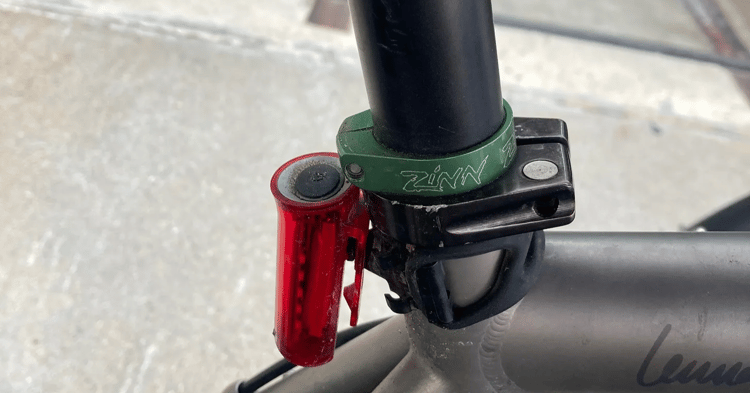
There are ways that you can stop seatpost slippage while out on a ride. And there are better, permanent fixes that you can do at home with more time, tools, and materials. Although this specifically addresses standard round-cross-section seatposts, seat tubes, and seatpost clamps, some of the principles apply to non-round seatposts and clamps, too.
Causes of seatpost slippage
The most likely causes of seatpost slippage are high rider weight, an insufficiently tightened seatpost clamp, or a seatpost with a smaller diameter than ideal for the frame. Riding surface is also important; bumpy roads and trails can inspire a seatpost to slip down.
The tolerance of the inside diameter of the frame’s seat tube and the outside diameter of the seatpost are critical. So is the seatpost material: chromed steel seatposts are harder, smoother, and more likely to slip than anodized aluminum ones, and the outer layer of many carbon seatposts can squish in and allow slippage.
The key to it all is the seatpost clamp. You may have noticed that the bolts in seatpost clamps and even the clamp bands themselves have become wimpier than they were a decade or two ago. While an M6 binder bolt that takes a 5mm hex key (right photo, below) used to be standard to adjust saddle height, now seatpost clamps almost always come with a skinnier, M5 binder bolt that takes a 4mm hex key (left photo, below).
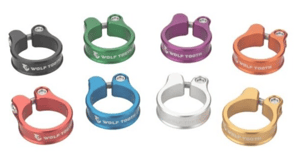
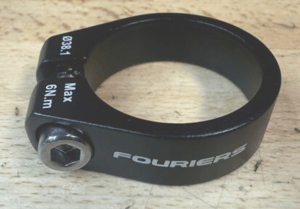
I believe that the shrinkage in binder bolt size is due to the advent of dropper posts and superlight carbon fiber seatposts. Overtightening the clamp around a dropper post can bind the post from snapping back up when you push the button and stand up after having dropped it down.
Carbon seatposts can get dangerously point loaded when clamped too tightly, and if the post breaks, the consumer tends to blame the seatpost manufacturer and the bike company.
The response by bike companies to issues with both seatpost types is to use a tiny bolt and a thin clamp band that can’t be tightened very tightly. They also may etch a low torque number into the clamp.
Especially with a carbon seatpost, you should avoid stacking up the slots in the seat tube and the seatpost clamp (many seatpost clamps come with an angled or offset slot for this reason). Rotate the seatpost clamp so that its slot and the seat tube slot do not line up. This avoids driving the top corners of the seat tube slot into a carbon seatpost and breaking some of its fibers.
Curing seatpost slippage
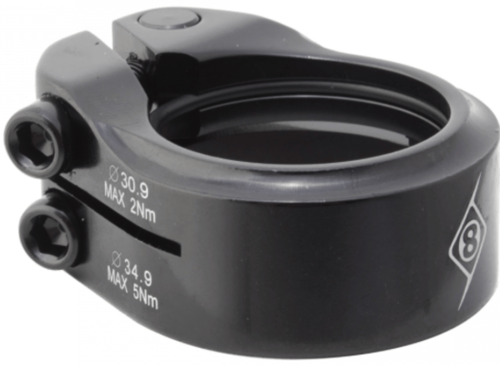
- Tighten the binder bolt. Obvious first step. Don’t exceed the recommended torque for the frame, the binder, or the seatpost. Another option is a two-bolt binder (below) for more friction without going to higher clamp torque. We sell these as well.
If the binder alone can't stop your saddle from getting lower as you ride, you will need to remove the seatpost. If your seatpost has a Shimano Di2 battery inside, take care when removing it to not unplug any of the wires. Take similar care when removing a dropper post. You will need to push the cable housing or hydraulic hose into the frame as you pull the post out to not damage the housing or hose. You may need to remove the trigger lever from the handlebar to get enough slack in the housing or hose to get the post all the way out.
- Create more friction between the seatpost and seat tube. If you are out on a ride, you can pull the seatpost out, rub sand into the grease that’s on it, reinsert it, and retighten the clamp. This is cheap and easy and may solve the problem.
A less messy and likely more effective option for creating more friction is to apply carbon assembly paste or spray to the seatpost shaft. This stuff is sticky or has small, gritty silica or plastic beads in the solution that press back against the clamp to increase the pressure uniformly and avoid point-loading while also protecting (like grease) against corrosion. You can also get small packets of it that you could carry in your seat bag.
- Shim the seatpost. If the seat-binder lug or binder clamp slot is pinched closed, and you still can’t get the post to not slip down, even with assembly (friction) paste, your seatpost and seat tube diameters don’t match closely enough. A large mismatch is of course addressed by getting the proper size seatpost; try the next size up and see if it fits into your frame.
Another possibility is that your seat tube has been adapted to fit your seatpost by means of a slotted cylindrical shim sleeve and that the shim sleeve is too thin. Seatpost shim sleeves are available in different diameters and thicknesses. They sometimes have the outer diameter of the seatpost and seat tube inner diameter they’re made for etched into them. If your seatpost’s diameter or your frame’s seat tube inner diameter don’t match the corresponding number etched into the shim sleeve, you’ve identified the problem. Get the correct shim.
The size discrepancy between inner and outer diameters may be too small to resolve with a larger seatpost or a thicker seatpost shim. In that case, you can cut a 1 × 3–inch piece of aluminum from a pop can as a shim. Pull the seatpost out, grease it and the pop-can shim, and insert both back into your frame. Bend the top lip of the shim over to prevent it from disappearing inside the frame. You may need to experiment with various dimensions of your beer-can shim until you find a piece small enough to go in with the seatpost and big enough to still prevent slippage.
- Add a second seatpost clamp. Stacking up a second binder clamp atop the one on the frame adds enough friction to keep the seatpost from sliding down even under a very heavy rider without over-torquing either clamp. Depending on what kind of secondary clamp you use, this will either be an elegant solution or an ugly one. The ugly solution is to tighten a hose clamp around the seatpost right above the seatpost clamp on the frame.
We offer a more elegant solution at Zinn Cycles (and at Clydesdale Bikes). On bikes for heavy riders, we install a secondary seatpost clamp machined to fit the seatpost rather than the outer diameter of the frame’s seat tube. It clamps around the seatpost above the frame’s seatpost clamp as you can see in the photos. This is a more aesthetically pleasing version—without a hose clamp’s sharp edges to hang up on your clothing or cut your skin. 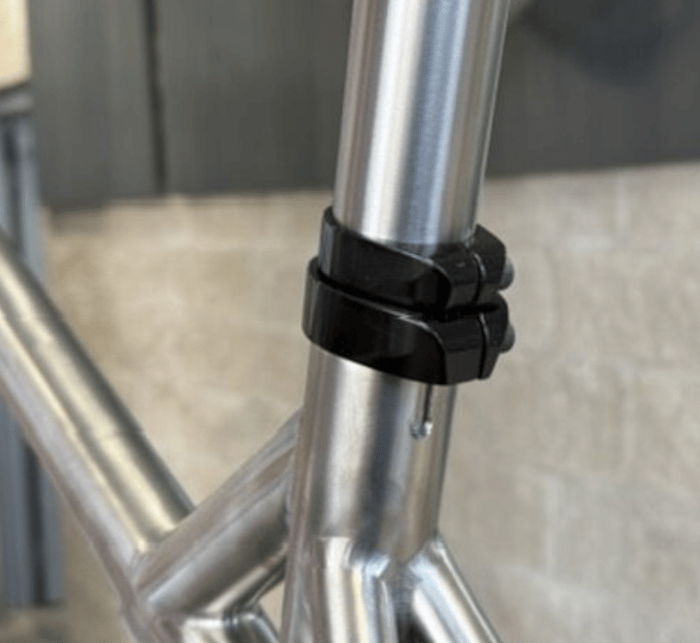
Any of these options except the machined secondary seatpost clamp can work with non-round seatposts.
― Lennard
Lennard Zinn has been designing and building custom bicycles for over 45 years; he founded Zinn Cycles in 1982 and co-founded Clydesdale Bicycles in 2017. His Tech Q&A column on Substack follows his 35-year stint as a technical writer for VeloNews (from 1987 through 2022). He is a former U.S. National Cycling Team member and author of many bicycle books including Zinn and the Art of Mountain Bike Maintenance, Zinn and the Art of Road Bike Maintenance, and The Haywire Heart. He holds a bachelor’s degree in physics from Colorado College.
Follow Lennard Zinn on Substack, Strava, X, Instagram, LinkedIn, or Facebook.